In this article
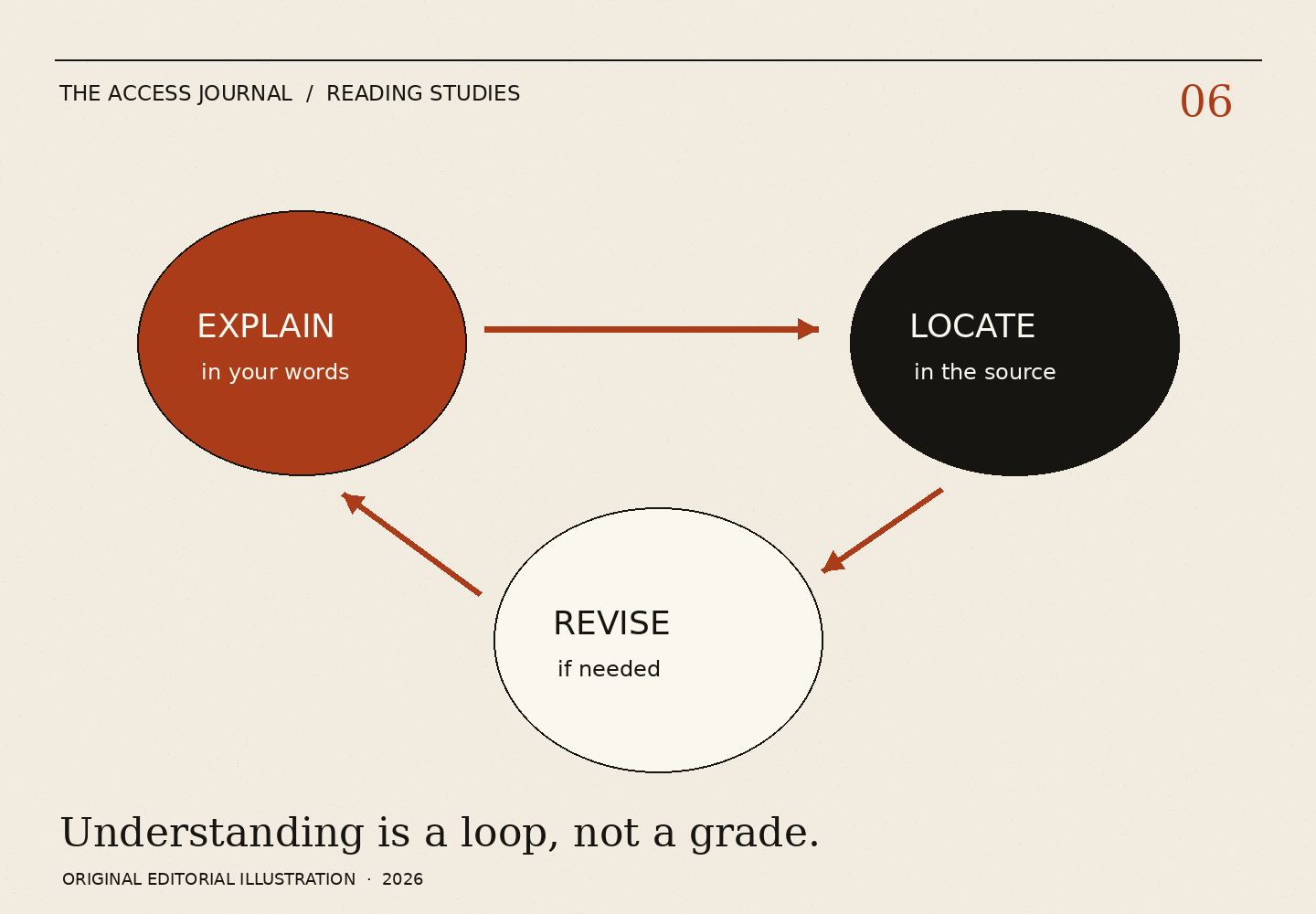
A nod can mean “I heard you,” “please continue,” “I want this conversation to end” or “I understand.” It is a weak measure of what a passage means to a reader. A more useful check is to explain one relationship in your own words and find the source that supports it.
This should not become an examination. The reader does not owe a performance to a helper. The purpose is to discover where the information or explanation needs work. A check that makes someone feel obliged to guess can produce confidence without understanding.
The method here is voluntary and reader-led. It does not assess literacy, capacity, disability or suitability for a product. It is also not a provider’s required procedure. It is a way to compare an explanation with a source before relying on the explanation.
Choose a relationship, not the whole document Ask what would be useful to understand at this stage. It might be which diagram label belongs to an explanation, where a heading begins or which part to read next. A single relationship is easier to inspect than a request to summarize ten pages.
Try saying, “I think this paragraph explains the middle label in the diagram.” Then point to the words that support that sequence. If the source says something different, revise the explanation. The correction is useful information, not a score.
Avoid a question that contains its own answer, such as “You know that this is optional, right?” That invites agreement. A neutral invitation is, “How would you describe the choice the paragraph gives?” The reader can answer, ask to hear the paragraph again or say that the choice is still unclear.
Let the source do some of the work Keep the source open. There is no need to remember every word. Finding the relevant sentence is part of using information well. If a helper insists that you explain it from memory, clarify that the task is understanding the document, not memorizing it.
A useful explanation can include a quotation of a few key words and a plain-language restatement. Label which is which. If the explanation depends on an inference, say so. For example, “The paragraph does not explicitly connect these two steps; I assumed the order.” That statement exposes the exact place where clarification may be needed.
Digital.gov’s audience guidance centers what readers need to know. Our method turns that emphasis into a self-check: can this reader use this passage for this question? It makes no claim that a successful check validates all the material or predicts later performance.
Use a different example without changing the rule After explaining a relationship, try a small fictional variation. If a sample diagram has labels for screen, paper and audio, imagine that their positions on the page change. Can you still match each explanation to its label? The variation tests the relationship rather than the reader’s memory of a left-to-right order.
Keep the variation close enough to the source that it tests the same relationship. Do not invent new financial facts, personal circumstances or provider features. The exercise can use neutral document labels and imaginary paragraphs. It should not become advice about a real transaction.
If the variation cannot be answered from the passage, say that. “The source does not establish this case” is a useful result. A good understanding check can reveal the boundary of a statement as well as its meaning.
A fictional conversation that changes the explanation Rae reads an invented diagram with a row for each reading format. A helper reads the middle row’s explanation after the first row’s label. Rae is not sure the pairing is right. Rather than agreeing, Rae traces the row back to its own label.
They revise the spoken outline together, placing each row label before its explanation. Rae then tries a variation: the rows are read from bottom to top, with the labels still attached. The relationships remain clear even though the order has changed. The helper checks the diagram and agrees that the revised reading is more accurate.
The important event is not that Rae passed a test. It is that the source corrected the helper’s explanation. A reader-led check makes room for the helper, the material or both to be the source of confusion. It does not place the entire burden on the person seeking help.
Ask what is still unknown A closing question such as “What is still unclear?” may be useful, but it can feel too broad. Offer a choice of relationships to inspect: the term, the condition, the sequence or the source reference. The reader can choose one or decline. Do not turn the categories into a diagnosis.
An explanation can be correct within a narrow scope and still leave an important issue unresolved. Write the scope next to it. “I understand which section is referenced; I have not read that section” protects against treating navigation as comprehension. “I can explain the general definition; I do not know whether it applies to this document” does the same for terminology.
If the unresolved point affects a consequential decision, the reading exercise cannot substitute for authoritative clarification. Use it to prepare a precise question. The journal does not interpret individual agreements, access an account or provide legal conclusions.
Change the communication rather than increasing pressure When a check does not work, repeating the same explanation more loudly or quickly is unlikely to reveal the missing relationship. Try a smaller passage, a different format or a source locator. Ask the reader which change would help rather than assigning a preference based on assumptions.
The DOJ’s general effective-communication guidance recognizes that the communication’s context and the person’s usual methods matter in covered settings. It does not endorse this exercise or establish that informal reading help is sufficient in a particular case. Formal communication needs and responsibilities require their own consideration.
A helper can say, “My explanation may have skipped a condition. Let’s find it.” That makes revision ordinary. It also prevents “checking understanding” from becoming a demand that the reader repeat the helper’s preferred answer.
Keep a usable result, not a grade End with a sentence that describes what was checked. For example: “I matched each diagram label to its explanation and can find the same row again.” Add the remaining question if there is one. No score or percentage is needed, and no conclusion about the reader follows from the exercise.
If you want to revisit the passage, keep the heading and question in a place you choose. If a helper made a note, review it before it becomes the record of your understanding. The record should reflect your explanation, including uncertainty, rather than an account of how quickly you responded.
The point of a reading check is to make the next use of information more deliberate. Sometimes the result is a clear explanation. Sometimes it is a better question or recognition that another format is needed. All three can strengthen control because they make the state of understanding visible to the person who will decide what happens next.