In this article
Practical help can make information easier to use. A second person might find a heading, read a paragraph, explain a word or write down a question. The help is most useful when the reader can say exactly what is wanted, change the arrangement and stop it without having to justify the change.
There is no single correct amount of independence. Doing every step alone is not the only way to remain in control. The important distinction is between receiving assistance you choose and having someone else quietly take over the task or decision. A good reading arrangement makes that distinction observable.
This article describes informal reading help. It does not create legal authority, authorize account access or replace a qualified interpreter, representative or other formal service. It is not a capacity assessment. The same practical boundaries can be useful for any adult reader, for any reason.
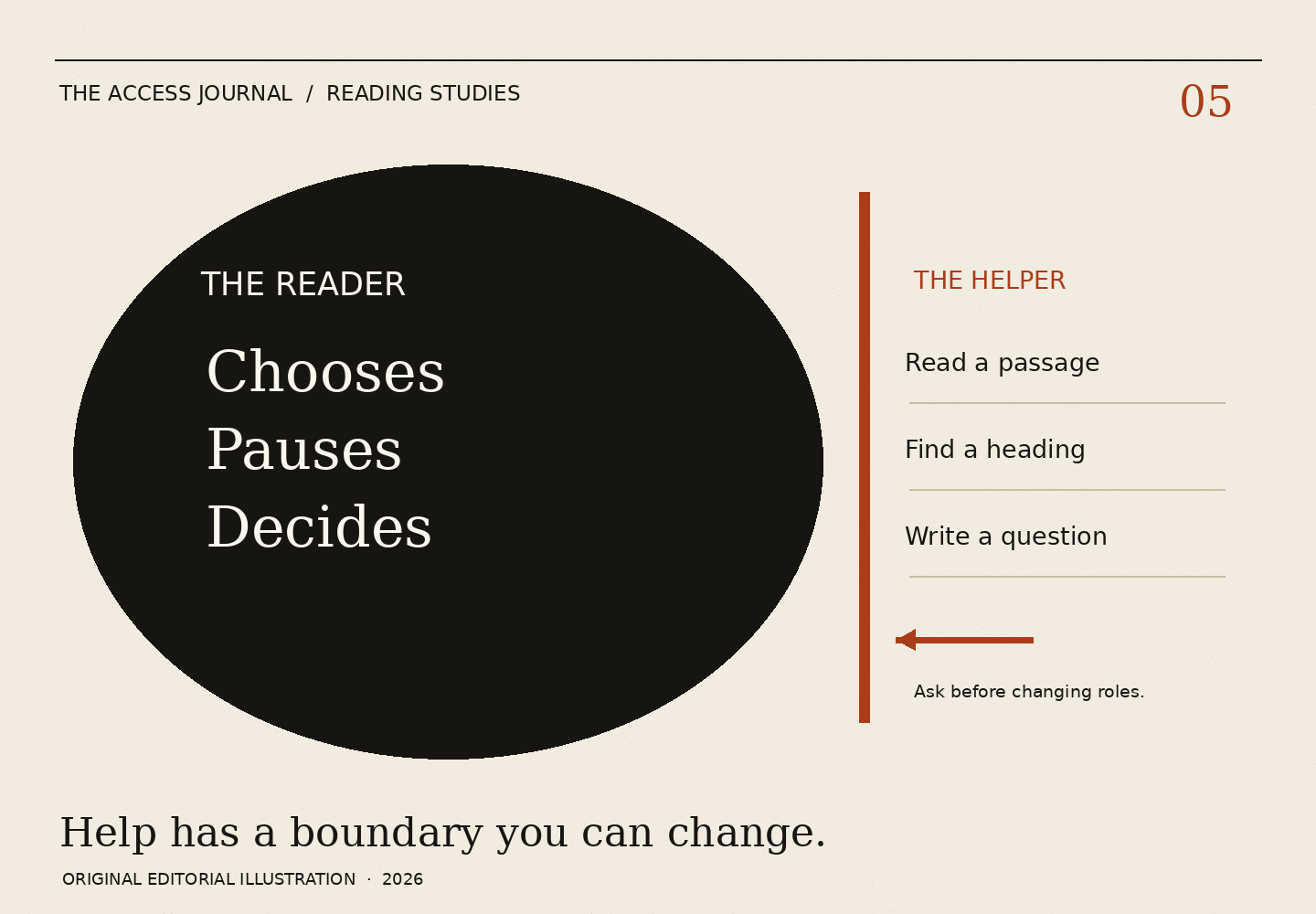
Describe the job as an action “Help me with this” leaves a great deal open. A more specific invitation might be “read the headings,” “find this word,” “write down my question” or “listen while I explain the paragraph.” Each describes an action the helper can complete without needing control of the whole situation.
Choose the action together, but let the reader decide its scope. If the helper notices another possible task, they can ask before changing direction. “Would you like me to find that definition?” leaves room for yes, no or later. It is different from opening other documents and continuing without a pause.
Make the end of the task visible too. “Stop after this section” or “Let’s do one question” gives both people a natural checkpoint. The checkpoint is not a deadline or a test. It is a chance to see whether the help is still useful.
Keep the object of help small Use the material needed for the agreed task. A public sample passage may be enough for practicing a reading technique. If the task concerns private information, decide carefully what the helper needs to see and what can stay out of view. Do not bring account credentials, security codes or identity documents into a general reading exercise.
You can control the page or paper yourself while another person reads. You can ask for a definition without showing an entire record. You can choose to keep notes yourself. These arrangements are options, not demands that everyone must use the same method.
A helper should not need to retain copies simply because they assisted once. Discuss whether any notes are being made and who keeps them. A note that records a public heading and an unresolved word may accomplish the purpose without preserving a private document. This site does not receive either kind of note.
Agree on a pause that actually stops the work A stopping signal can be an ordinary word, a gesture or another method the reader chooses. It should be clear enough that the helper knows to stop reading, speaking or navigating. The helper should wait for the reader to decide whether to repeat, change tasks or end the session.
The signal should not require a debate. “One moment” can mean one moment. A reader may need time to compare the explanation with the source or may simply want to stop. Asking why is not necessary for the helper to respect that boundary.
Practice once with harmless material if the arrangement is unfamiliar. The reader signals, the helper stops, and the reader chooses the next step. This makes the boundary real before the material becomes demanding. It is a coordination exercise, not a judgment about either person.
Distinguish reading, explanation and recommendation A helper reading the exact words should say when they shift into an explanation. An explanation should be marked as their understanding. A recommendation about what the reader should choose is another step again, and may be outside the help that was invited.
For example, “The paragraph says there are two options” is a reading observation. “I think the second option has this condition” is an interpretation that needs checking. “You should choose the second option” is advice. Moving through those stages without labeling them makes it harder for the reader to know what came from the source.
A useful response from the reader is, “Show me the sentence that supports that.” The helper can point to it, revise the explanation or acknowledge uncertainty. Confidence is not a substitute for a source. Neither person has to fill a gap just to keep the session moving.
A fictional partnership with a changed boundary Nico asks a friend to read a sample payment-information paragraph aloud. They agree that the friend will read exactly, pause after each paragraph and leave the questions to Nico. Halfway through, the friend begins explaining what they think the writer intended. Nico says, “Please finish the words first.” The friend stops the explanation and returns to the agreed role.
After hearing the paragraph, Nico chooses to ask for an explanation of one term. The scope changes because Nico asked for the change. The friend gives an ordinary-language explanation and identifies it as their own. Together they check whether the source defines the term differently.
One point remains unclear. The friend offers to write a question; Nico agrees, reads it back and changes a word that did not express the intended meaning. The final note belongs to Nico and contains the source heading and question. The friend has not selected an option, entered an account or assumed authority to speak in a later conversation.
This example does not require the friend to be perfect from the start. It requires the boundary to work when corrected. A collaborative session can include mistakes and repairs while keeping the reader’s direction effective.
Know when informal help is the wrong arrangement Some material or conversations require accuracy, impartiality or specialized communication skills beyond what an informal helper can provide. The DOJ’s effective-communication guidance explains that covered entities have responsibilities and that relying on accompanying people as interpreters has limits. A friend’s presence does not automatically settle those responsibilities.
The Corpay Prepaid public homepage specifically says it accepts operator relay calls. That is a narrow published statement. It is not evidence that every requested aid, document format or language service is available, and this journal has not tested a call or authenticated account workflow.
If a different arrangement is needed, describe the communication task and ask the relevant organization about an appropriate method. Do not treat an informal helper’s availability as the only possible route. This article cannot decide legal coverage, entitlement or suitability in an individual case.
Leave the reader with the result At the end, the reader should have the source locator, the useful explanation and the remaining question in a form they can use. The helper can ask, “What do you want to keep?” rather than deciding which interpretation will be remembered. If the reader wants no note, that is also a choice within this exercise.
Check whether any temporary material should be returned or removed through the agreed process. Do not make permanent copies as a default. If the session will continue, agree on the next task rather than treating one invitation as ongoing permission.
The measure of good assistance is not how quickly the helper finishes. It is whether the reader can interrupt, understand what happened and choose the next step. Help that strengthens those abilities supports independent control, even when more than one person is involved.